Tracking Climate-Smart Solutions for Almond Orchards from the Field and the Sky
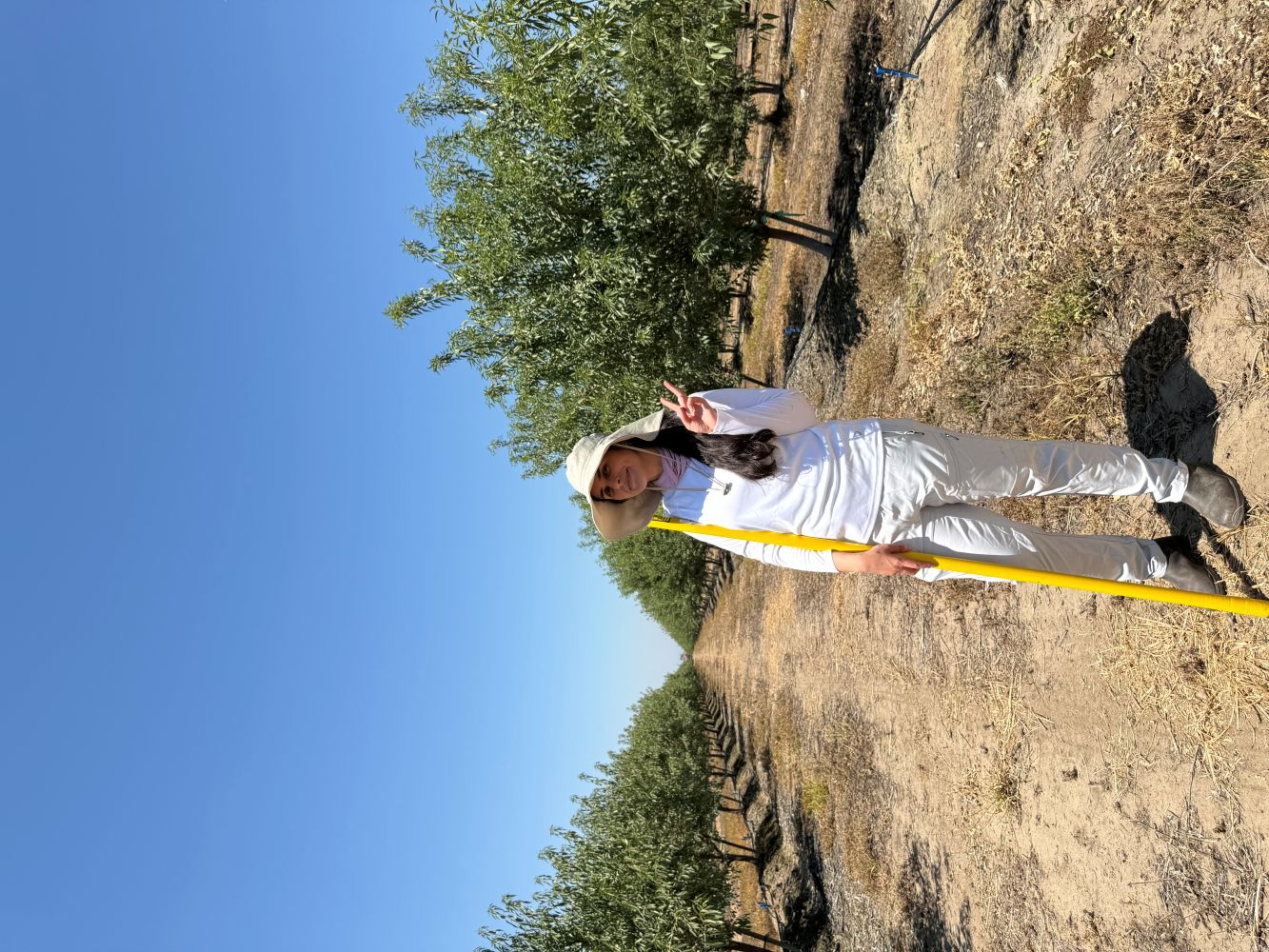
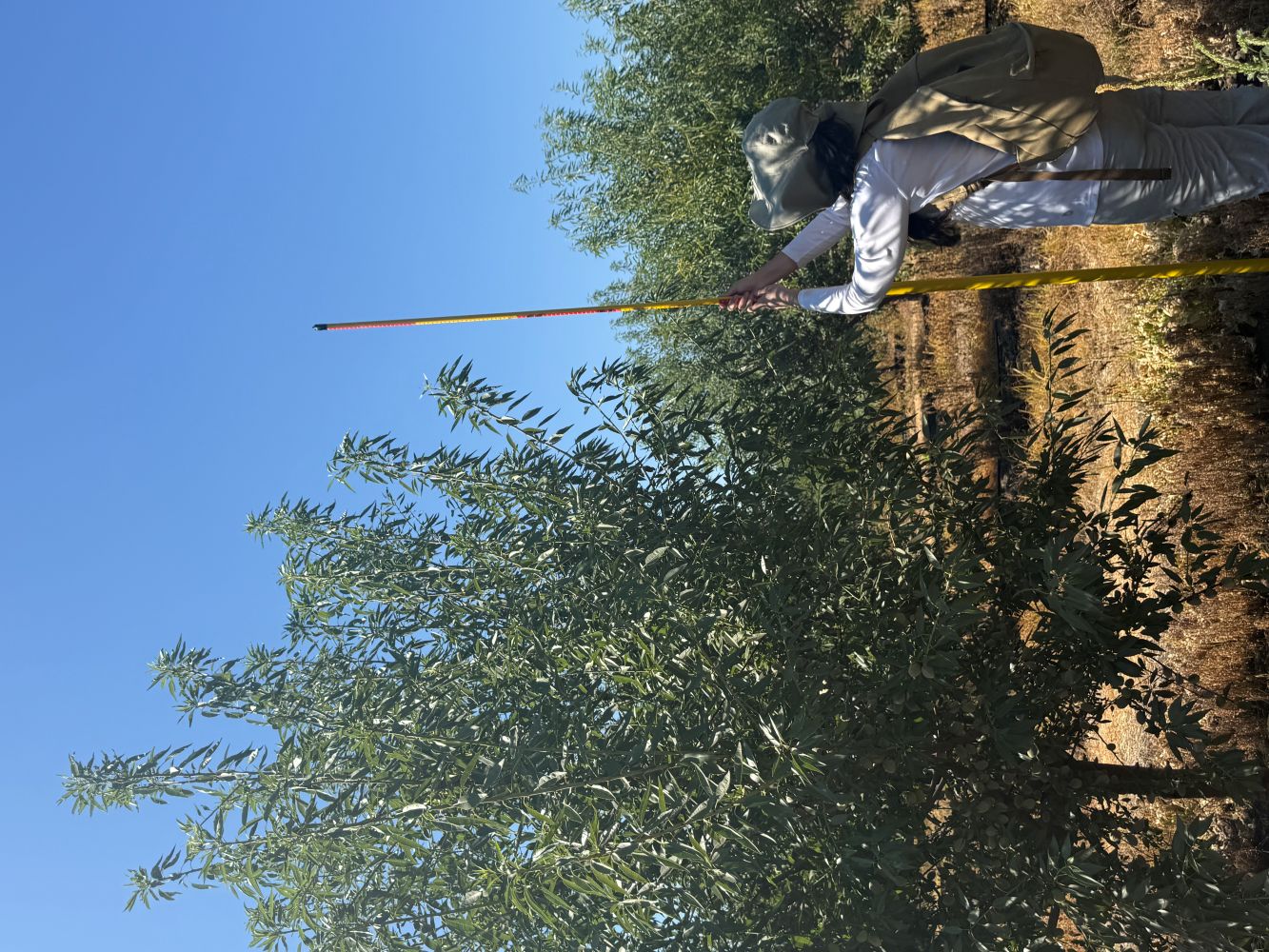
My project is part of a multi-year study that investigates the impact of stacked climate-smart solutions, including whole orchard recycling and almond biochar compost, on almond trees. My project focuses on the impact of these sustainable agriculture practices on young almond trees. I spent summer 2025 in the field at the 98-acre experimental almond orchard site in Ceres, CA where I measured the height of 720 almond trees. This data collection day coincided with our imaging partners’ (Ceres AI) flyover campaign.
To understand my research, understanding the footprint of the California almond industry is necessary. Almonds are more than just a popular food; they are a multi-billion-dollar agricultural industry and California’s second-largest agricultural commodity. However, cultivating them in the Central Valley is resource-intensive.
Between their high water and fertilizer demands, alongside California’s recurring droughts, the long-term sustainability of the industry is under major pressure. To keep producing almonds, moving toward regenerative, climate-smart agricultural practices might be the most sensible option. This study aims to figure this out.
Whole Orchard Recycling One of the biggest issues in almond farming happens at the end of an orchard's 20- to 25-year lifespan and determining what to do with all the woody biomass. Historically, farmers would rip out the old trees and burn them, which harms air quality, or ship them to power plants.
Today, a much more sustainable alternative called Whole-Orchard Recycling (WOR) is taking root. Instead of removing or burning the old trees, WOR involves grinding them into woodchips and tilling them back into the topsoil before replanting a new orchard. Decades of research show that WOR works wonders for the soil. It boosts soil carbon, increases organic matter by over 40%, improves water holding capacity, and builds a healthier microbial community.
Stacking Solutions While WOR is a fantastic practice, it isn't a silver bullet. It has been found that a massive influx of woody carbon can temporarily tie up nitrogen in the soil. My research explores what happens when we combine WOR with other organic matter amendments, specifically, almond-shell biochar.
Biochar is a carbon-rich substance created by heating biomass in the absence of oxygen. When added to the soil, it acts like a sponge and enhances the soil's ability to hold onto water and nutrients. By stacking biochar with WOR, I hypothesize that this could create a synergistic effect. The biochar could help stabilize the decomposing woodchips and boost moisture retention, which would then make the young trees more resilient to water stress during San Joaquin Valley summers.
While the soil benefits of these amendments are well-documented for mature trees, there is a knowledge gap regarding how this combination of sustainable agriculture practices impacts the development of young trees. Do they grow faster? Are they less stressed?
My project also bridges the gap between traditional agronomy and geospatial technology. Using high-resolution multispectral and thermal cameras mounted on aircraft, we captured non-destructive, highly scalable data. These remote sensing tools let us look beyond what the naked eye can see. By analyzing vegetation indices like NDVI (which measures canopy greenness) and remotely-sensed thermal indicators, we can detect physiological stress in the trees long before they show physical signs of stress. This experiment is broken down into three main treatment groups to track early-life changes: a control group with no soil amendments, a WOR-only group, and a stacked WOR + biochar group. Over the course of the study, Ceres AI conducted 14 flyovers to collect multispectral data, which I am now comparing against the physical measurements our team and I gathered in the field.
Going into the data analysis, I have a few strong hypotheses. I anticipate that the young trees grown in the stacked WOR and biochar plots will show higher canopy vigor and greener leaves compared to the other groups. Furthermore, during peak summer water demand, I expect the biochar to act as a buffer that will reduce tree water stress and I believe that this difference can be mapped using our in-field stem water potential data and our thermal aerial imagery. Ultimately, I believe the compounding benefits of this stacked treatment will result in structurally larger, healthier trees.
Intense weather events aren’t going anywhere, and neither is the global demand for California almonds. By understanding how to better recycle old almond orchards and amend the soil with biochar, we can equip farmers with the tools they need to conserve water, lock away carbon, and ensure that their young trees thrive for decades to come.