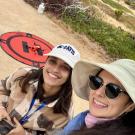
When hundreds of researchers, practitioners, funders and partners gathered at the International Livestock Research Institute campus in Nairobi for CGIAR Scaling Week, UC Davis was represented in a particularly meaningful way.
Todd Rosenstock and Timothy “Tim” Krupnik - both graduates of the UC Davis master’s program in International Agricultural Development - now lead two of CGIAR’s major systemwide research programs. Rosenstock serves as Director of the CGIAR Climate Action Program, while Krupnik is Director of CGIAR’s Scaling for Impact Program, which convened Scaling Week.
Join us for IAD Prospective Student Day on Monday, October 26, 2026. This is a full day on the UC Davis campus — visits to research facilities, conversations with faculty from across disciplines, a keynote from university leadership, and an evening to connect with current students.
Whether you're seriously considering applying or just starting to explore your options, this day is designed to give you a real and honest picture of what the IAD program is, who it's for, and what your graduate experience could look like.
Every four years, horticultural scientists from around the world gather for the International Horticultural Congress. This August, the congress took place in Kyoto under the theme “Exploring the Diversity of Horticulture.” The Executive Director and faculty connected to UC Davis’s International Agricultural Development (IAD) program contributed to discussions spanning nutrition, climate resilience, agricultural investment, and postharvest loss.
We are excited to welcome prospective students passionate about making a difference in food systems, agriculture, and global health. This fall, the UC Davis International Agricultural Development (IAD) Graduate Program is hosting a series of free online information sessions designed to help you learn everything you need to know about the program, and decide if IAD is the right next step for you.
The UC Davis International Agricultural Development (IAD) Program is pleased to welcome Dr. Erin McGuire as its new Executive Director. McGuire is a graduate of the IAD Graduate Program herself and is excited to be back leading "one of the world's best international agricultural programs."
In this position, she aims to bring the UC Davis program to the forefront of global food systems work and create new connections for students, international organizations, and global universities.
My project is part of a multi-year study that investigates the impact of stacked climate-smart solutions, including whole orchard recycling and almond biochar compost, on almond trees.
Women play a central role in rural agriculture. They contribute significantly to household food production, particularly by cultivating staple crops such as maize and beans. Yet despite their contributions, women farmers often face systemic barriers: limited access to land, credit, inputs, and agricultural extension services.
On June 2, IAD graduate students gathered at the University of California, Davis for the annual IAD Graduate Symposium, an afternoon dedicated to sharing thesis research and connecting with students and alumni working across the food and agriculture sector.
My thesis research focuses on supporting small-scale farmers to sustain and advance their cacao production. I traveled to rural Colombia and partnered with Universidad de La Salle Utopía, Unitrópico, and Andean Cacao Company to work with small-scale cacao farmers, learning about their diverse production and the barriers to achieving higher yields and profits.
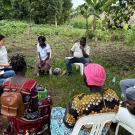
In Uganda, women play a key role in agriculture. They are the backbone of household food production and rural livelihoods. Yet, they often remain excluded from access to productive resources such as land, inputs, and extension services. This exclusion is even more pronounced among women with disabilities, who face both gender-based and disability-related barriers.
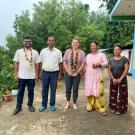
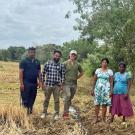
With support from the Jastro-Shields Research Award and the Graduate Fellowship for Agricultural Development (GFAD) and in collaboration with the agricultural research organization CIMMYT, I spent 2 months in Nepal this summer conducting field research with smallholder farmers.
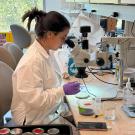
We are conducting laboratory toxicity assays using the standard oribatid mite species, Oppia nitens. In these experiments to further explore how habitat quality influences soil resilience to contaminants.
In 2021 Sri Lanka became the first modern country to attempt to transition its agriculture sector to 100% organic practices, following a Governmental ban on the importation of synthetic fertilizers, pesticides and weedicides. It did not go as planned.
California’s Sacramento Valley, known for its hot, dry summers and abundant sunshine, produces the second-highest rice yields in the world after Australia. However, rising temperatures and more frequent extreme events such as droughts, heat waves, and cold events are expected to challenge this productivity.